

Q&A: Dr. Nancy Hurst
The first lactation consultant Texas Children's Hospital ever hired and a driving force behind their successful in-house milk bank, Dr. Nancy Hurst continues to change the way Texas understands the importance of breastfeeding and human milk use for premature infants.
Nancy M. Hurst, RN, PhD, IBCLC, is the Director of Women’s Support Services at Texas Children’s Hospital, where she has worked as an international board certified lactation consultant for over 30 years. In 2007, she received her Ph.D. in Nursing from the University of Texas Health Science Center at Houston, and she has published research articles in the Journal of Human Lactation, Breastfeeding Medicine, the Journal of Perinatology and many others. Her research has focused on the importance of breastfeeding and the use of mother’s own milk in the NICU, as well as on the barriers mothers and hospitals face when trying to provide this nutrition. She recently joined the Texas Collaborative for Healthy Mothers and Babies Neonatal Subcommittee as Co-chair, where she works on the initiative to increase breastfeeding and human milk use in NICUs across the state. She describes herself as “passionate about providing the best possible support and resources to families who are breastfeeding their infants.”
By Kaulie Lewis
Population Health Scholar
University of Texas System
Master's Student in Journalism
UT Austin Moody College of Communication
Dr. Hurst, you’ve been working with new mothers for over 30 years and you’re now the head of Women’s Support Services at Texas Children’s Hospital, but take us back to the beginning. How did you become a lactation consultant? What was your original interest?
I had babies! I had four babies, and during those years I was a stay-at-home mom but I still wanted to be busy outside the home, so I began teaching prepared childbirth classes.
At that time, at least in Houston, there was only one organization that offered prepared childbirth classes like Lamaze classes. Hospitals didn’t offer them. So I taught those classes as part of that organization and I also taught a breastfeeding class. Between teaching and then breastfeeding my own children, I got very interested.
Then we had someone come to our organization from Baylor College of Medicine, a Ph.D. prepared scientist named Judy Hopkinson, and she gave a presentation about lactation. I met her and was even more interested in the subject. When a job became available at Texas Children’s, she called me and said, would you like to interview? At the time my youngest was a little bit older and I was thinking about going back to work for several reasons, so that started it.
I was so fortunate because there were physicians at Texas Children’s at the time who were very interested in studying human milk and the feeding strategies for preterm infants in the NICU. A lot of that research was really starting to ramp up in the late 80s, so it was a perfect time to get involved in the field because over the decades I have been able to watch as the science has progressed.
So, that’s really where my interest came from. I went back to school and eventually got my Ph.D. and it’s been a very interesting ride. It’s still very interesting.
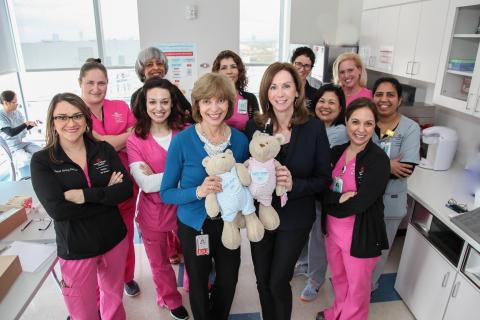
Dr. Nancy Hurst (center, in blue) with her colleagues at Texas Children's Hospital
As somebody who’s not a scientist but just looking at the overall picture and trying get the lay of the land in this field, it strikes me as kind of crazy that those classes once weren’t offered in hospitals.
Yeah, and actually not long after I started work at Texas Children’s, the organization that offered those classes folded because all the hospitals started offering them. There was such a demand by the patients, “we want to take prepared childbirth classes,” and the hospitals saw that if they wanted any kind of control over the content then they had better offer those classes themselves. That kind of dried up all the customers for the other organizations.
You recently joined the Texas Collaborative for Healthy Mothers and Babies’ initiative to increase breastfeeding and human milk use in NICUs. How did you first become involved in the TCHMB?
Dr. Charleta Guillory, one of the neonatologists at Texas Children’s Hospital who’s very involved with the collaborative, was the one who got me involved with TCHMB. I think she encouraged me to join because of my experience with breastfeeding and human milk, specifically for mothers with preterm infants.
I’ve been involved in this particular area of mother’s milk in the NICU since I first started at Texas Children’s Hospital in 1984. I was the first lactation consultant they had ever hired, and this was even before there were International Board Certified Lactation Consultants (IBCLCs). You just called yourself a lactation consultant since that was your area of interest and expertise.
So Texas Children’s hadn’t had a lactation consultant in the hospital before, much less one in the NICU. That was challenging, but we’ve been working on increasing breastfeeding and human milk use in the NICU since we began lactation services.
So that’s really how it started, and I’m very excited about it. It’s so nice to learn from other people around the state, and from the initiatives they’ve been involved in to increase mother’s milk feeding in the NICU.
You’ve done so much research and work in this area. Can you tell me a little bit about some of the barriers to human milk use in the NICU, and about how the collaborative is addressing those? What changes have you seen?
I think it all starts with the mother and with giving her the support that she needs from the very beginning. We need to make sure that she’s tapping the available resources, by, for instance, procuring a hospital-grade breast pump for her and helping her initiate and then maintain her milk production.
At Texas Children’s we’ve had such a great opportunity in the last five years since the Pavilion for Women was opened, because now we have more direct impact on the mothers right after delivery when we know their babies are going to the NICU. Before we opened the Pavilion, all of our NICU babies were out-born. They were transferred to Texas Children’s after delivery, and we didn’t have that same access to the mothers.
The other thing is just continued support throughout the baby’s hospitalization. From my research, and from interviewing mothers and asking them about the pumping experience, I know it is so much work. It’s very challenging for all of them. Not only do they have a baby in the NICU, but then they’re burdened with having to pump at least 6 times a day, if not more, to make and maintain their milk volume. It’s not pleasant, they don’t enjoy it, and so that’s challenging as well. So we’re focused on learning how we can best help these mothers so that we can ensure that their babies get their milk.
Some collaborative members are leading new initiatives to improve the communication and connection between lactation consultants, nurses, and mothers who may be struggling. As somebody who’s been in the field for a long time, can you speak at all to how those relationships or expectations have changed? How important is maintaining that communication line with these mothers?
It’s incredibly important, and if a hospital has lactation consultants there to help these mothers, then they’re very fortunate. But what I’ve learned over the years is that when you have a specific program that includes lactation consultants, much of the time the nurses at the bedside feel like, “That’s not my job, that’s not me. I’m not a lactation consultant.” That really is not the best model.
There are certainly things that the lactation consultants can do best and as feeding specialists they can partner with the nurses, but it’s so important to have the nursing staff engaged. It’s best for the nurses to be knowledgeable about what is required to initiate and maintain lactation as well as knowing how to initiate direct breastfeeding. You really need both. And if you don’t have that level of knowledge and cooperation, it’s very challenging, because you’re never going to have enough lactation consultants.
Texas Children’s now has its own human milk bank, and you were very influential in getting that started. What is the program and that process like? How did you bring this to Texas Children’s?
Well, there were several objectives for starting the lactation and milk bank services. When the program started in the mid-1980s, there was interest at Texas Children’s in studying the effects of feeding mother’s milk. When the first study began, the investigators quickly realized that although some of the mothers were initiating pumping, they were not continuing to pump. It became clear that a focused support for these mothers was needed to improve outcomes.
Then it was decided that it would be better for everyone if the milk was stored in more of a centralized location adjacent to the NICU. That way there would be better quality control in the handling of mother’s own milk, and better control over its collection, transport, storage and preparation. So we developed a physical space right outside the NICU where we could store and prepare that milk. For lack of a better name, we called it the milk bank, and that stuck.
Nowadays, and even at that time, the term “milk bank” is used in a different context. I’ve certainly been told that what we have is not a true milk bank. But our thought was that the mothers are making a deposit and the babies are making a withdrawal, so it’s a bank! You’ll hear some people call them milk labs now. But it was, if not the first, then one of the first of its kind that was hospital-based. So, we’ve always called that our milk bank.
You say that the meaning of a “milk bank” has changed over the last 30 years. Have your milk bank operations at Texas Children’s changed as well?
Yes, absolutely, in both size and scope. Until the early 2000s, all we did was store and prepare mother’s own milk, when Dr. Richard Schanler and others began studies on the use of pasteurized donor milk. At that point we were starting to order donor milk from one of the Human Milk Banking Association of North America (HMBANA) milk banks, either Austin, North Texas, or Denver, but that milk was used only in the context of a study protocol.
Then we participated as one of 12 sites for a study on the use of Prolacta, which is a human milk-based dietary fortifier for preterm, very low birth weight babies. These babies are so small we can’t give them large volumes of milk because they’re fluid-restricted and have greater needs than full-term infants, so to provide them with enough calories and minerals to grow, you have to fortify either mother’s own milk or donor milk. Up until this time, the only fortifiers available were made from cow’s milk, which contains proteins that these low birth weight babies have difficulty processing.
When this study had these babies on an exclusively human milk fed diet, one of the outcomes was a 75 percent decrease in the risk of surgical necrotizing enterocolitis (NEC). As a result of those findings, we changed our feeding protocol in the NICU so that infants under a certain birthweight would only receive mother’s own milk fortified with Prolacta human milk fortifier. Pasteurized donor milk was given when mother’s own milk was not available.
"From my research and from interviewing mothers and asking them about the pumping experience, I know it is so much work. ... So we're focused on learning how we can best help these mothers so that we can ensure their babies get their milk."
We started that protocol in 2009, and we were getting the donor milk we needed from one of these HMBANA milk banks. But even before we opened the Pavilion for Women in 2012, we were having problems getting our orders filled given the size of our NICU. We became concerned because we knew that when the Pavilion opened, 42 NICU beds would be added to Texas Children’s, and our need for donor milk was going to be even greater.
At that point we started to have some conversations with Prolacta Bioscience, the company that provides the human milk fortifier, about purchasing donor milk from them. In those discussions they said, you know, we’ve had some hospitals that become milk banks. What that means is that if a mother wants to donate her excess breast milk for babies in your NICU, then they go through our qualifying process. If they’re qualified as donors then we send them shipping materials, they pack up their extra breast milk and ship it to the Prolacta facility for processing. Once processed, you order what you need for your NICU babies.
Ultimately we decided to join that program and start a milk bank program for Texas Children’s. Our main reason was to ensure that we would have a reliable supply of donor milk to meet our needs, so while we pay a premium cost for the processing of the milk from Prolacta, we think that in the end this was a good decision.
And so that’s what our milk bank is now, those are our operations. We have two physical spaces – one in the Children’s hospital and one in the Pavilion – where the milk that moms express for their babies is stored. Specially-trained technicians then mix and prepare the milk and deliver the individually-prepared and labeled feedings to the baby’s bedside. But then we also have this other relationship with Prolacta where women can qualify to donate their excess breast milk for babies in our NICU whose mothers are unable to provide all their infant’s needs.
The evidence is still clear, though, that mother’s own milk is by far the best. Ultimately we would like to order very little donor milk. We’ll still need the fortifier, obviously, but we’re also very interested in seeing what the right population is in terms of birth weight, seeing which babies really need this more expensive human milk based fortifier. We’re trying to learn at what point they can be weaned from it safely so that we can continue to have these low incidences of NEC.
Who is donating to the Texas Children’s milk bank?
The mothers who donate their excess milk usually have a relationship with our NICU or Texas Children’s Hospital. Their generosity in sharing their milk and giving their time has been so wonderful to see.
The bulk of our donors are Texas Children’s employees or Baylor College of Medicine employees, as well as some of our NICU moms. Some of them produce so much milk that when their baby gets close to discharge they talk to us, saying, “you know, I don’t have room for all this milk at home. I’m still pumping and I’m planning on breastfeeding, but there’s no way I’m going to use all this milk.” Then we suggest that they consider milk donation.
It’s awesome to see that support, for these women to be willing to do that for each other.
Absolutely! It’s especially touching when it comes from moms whose babies have passed away during their hospitalization. We used to not approach mothers in these circumstances, but then we learned they were actually upset when they found out that milk donation was possible. After all, they had worked so hard to express their milk. Some moms have continued to pump even after their baby has died because they want to give back. It just blows my mind.
We started approaching these mothers about donation long before we started our own milk bank donation process. We would direct them towards one of the HMBANA milk banks to donate, and they were always so grateful. They said it really helped them through that grieving process.
At a state level, Texas has two of these HMBANA milk banks, which seems kind of unusual. Do you have any idea why that is, why there’s that level of involvement and support here in the state?
Well, we are a big state! I do know a few hospitals in Austin were using pasteurized donor milk in the NICU several years before the studies we discussed earlier had been done, and that may be one reason why the Austin Mother’s Milk Bank was the first one in Texas. North Texas Milk Bank followed a few years later.
When the AAP came out with their recommendations several years ago, saying that all babies should get mother’s own milk, including preterm infants - that was a game changer. And the AAP went on to say that if mother’s own milk was not available then those infants should get pasteurized donor milk. Those changes in recommendations, as well as the science behind them, have driven the need for having these milk banks in Texas. As we like to say, mothers have a lot of choices – but regardless of which milk bank you choose, please donate!
Now we’re constantly fighting this assumption that mother’s milk and donor milk are equivalent. They’re certainly not. Mother’s own milk is going to provide the biggest benefit, because the processing that goes on with the donor milk is going to alter some of those bioactive components. So you can’t say that they’re anywhere near equal, but certainly donor milk is a better substitute than formula, especially for those very low birth weight infants.

Neonatal Subcommittee Update
The goal of the initiative, and its associated learning collaborative, is to increase the number of very low birth weight infants that will receive human milk, preferably their mother’s milk, as their primary source of nutrition to assist with their immune and gastrointestinal tract development. More specifically, this project is focused on helping participating hospitals identify and overcome barriers to establishing maternal milk supply and barriers to supporting breastfeeding in the NICU. Initiative to Improve Infant Nutrition and Care in NICUs
The Neonatal Subcommittee is responsible for initiating and overseeing the Increasing Breastfeeding and Human Milk Use in the NICU initiative.
The goal of the initiative, and its associated learning collaborative, is to increase the number of very low birth weight infants that will receive human milk, preferably their mother’s milk, as their primary source of nutrition to assist with their immune and gastrointestinal tract development. More specifically, this project is focused on helping participating hospitals identify and overcome barriers to establishing maternal milk supply and barriers to supporting breastfeeding in the NICU. Initiative to Improve Infant Nutrition and Care in NICUs
Currently there are nine Level III & six Level IV hospitals participating in the project, as well as two observing hospitals. Approximately 800 NICU beds are covered by the project.
The learning collaborative is designed to enable teams to share, test, and implement ideas for improving rates of human milk and breastfeeding among very low birth weight babies.
In particular, the collaborative working to increase the use of human milk and breastfeeding by focusing on components of a “NICU Breast Milk Feeding Bundle.” This bundle was developed through discussion through the participating hospitals throughout the state who have all been working to increase breastfeeding and the use of human milk in the NICU, and is informed by the extensive literature on breastmilk utilization in the NICU.
For more information on the initiative, visit the intervention page on this site.
Obstetrics Subcommittee Update
The Obstetrics Subcommittee continued working on its Induction of Labor (IOL) Quality Improvement (QI) project, to reduce failed indicated induction of labor and ultimately reduce the primary cesarean delivery rate in Texas.
August 2017
The Obstetrics Subcommittee continued working on its Induction of Labor (IOL) Quality Improvement (QI) project, to reduce failed indicated induction of labor and ultimately reduce the primary cesarean delivery rate in Texas.
Currently, four hospitals are participating in this QI project. Of these four, one hospital is the farthest along with completion of baseline data collection, and is possibly planning to implement the IOL protocol in fall 2017. The project has recently been launched in the remaining three hospitals.
The IOL QI project entails the adoption of a standardized IOL algorithm plus additional action steps as determined by the participating hospital.

Research Articles, Recommended by Our QI Chairs
We asked the chairs of our QI initiatives to share some of the research they've found valuable over the last few months. Here are the highlights:
We asked the chairs of our QI initiatives to share some of the research they've found valuable over the last few months. Here are the highlights:
From Dr. Nancy Hurst, Co-Chair of the Neonatal Subcommittee:
From Clinics in Perinatology: "Preterm Human Milk Macronutrient and Energy Composition: A Systematic Review and Meta-Analysis"
From Breastfeeding Medicine: "Barriers to Human Milk Feeding at Discharge of Very-Low-Birth-Weight Infants: Maternal Goal Setting as a Key Social Factor"
From the Journal of Perinatology: "Buccal administration of human colostrum: impact on the oral microbiota of premature infants"
From Dr. Christina Davidson, Co-Chair of the Obstetrics Subcommittee:
From Obstetrics and Gynecology: "Mechanical and Pharmacologic Methods of
Labor Induction: A Randomized Controlled Trial"
From ACOG Committee Opinion: "Management of Suboptimally Dated Pregnancies"
From June Hanke, Co-Chair of the Community Health Subcommittee:
From Obstetrics & Gynecology: "Maternal Cardiovascular Mortality in Illinois, 2002-2011"
From Maternal Child Health Journal: "Views of Women and Clinicians on Postpartum Preparation and Recovery"
From Janet Jones, Co-Chair of the Community Health Subcommittee:
From Pediatric Research: "The impact of intrauterine and extrauterine weight gain in premature infants on later body composition"
From Early Human Development: "A new type of swaddling clothing improved development of preterm infants in neonatal intensive care units"
From Dr. Catherine Eppes, Co-Chair of the Data Subcommittee:
From the Society for Maternal-Fetal Medicine: "Special Report: Current approaches to measuring quality of care in obstetrics"
From the Society for Maternal-Fetal Medicine: "The development and implementation of checklists in obstetrics"
From the American Journal of Obstetrics & Gynecology: "Reduction of severe maternal morbidity from hemorrhage using a state perinatal quality collaborative"
From the American Journal of Obstetrics & Gynecology: "Early standardized treatment of critical blood pressure elevations is associated with a reduction in eclampsia and severe maternal morbidity"
Maternal & Infant Health MMWRs
Differences in breastfeeding rates for black and white infants persist across the country, with serious health impacts. This and other recent CDC MMWRs related to maternal and infant health can be found here.
The Morbidity and Mortality Weekly Report (MMWR) is prepared by the Centers for Disease Control and Prevention (CDC). Published MMWRs aim to include “timely, reliable, authoritative, accurate, objective and useful public health information and recommendations.”
Below are selections from recent MMWRs that may be relevant to our TCHMB readers and collaborators, including “Racial and Geographic Differences in Breastfeeding – United States, 2011-2015.”
From Sept. 15, 2017 MMWR:
From Sept. 1, 2017 MMWR:
From August 25, 2017 MMWR:
"CDC Grand Rounds: Newborn Screening for Hearing Loss and Critical Congenital Heart Disease"
From August 11, 2017 MMWR:
From July 28, 2017 MMWR:
"CDC Grand Rounds: Addressing Health Disparities in Early Childhood"
From July 21, 2017 MMWR:
From July 14, 2017 MMWR:
“Racial and Geographic Differences in Breastfeeding – United States, 2011-2015”
From June 23, 2017 MMWR:
From June 16, 2017 MMWR:
From April 28, 2017 MMWR:
“Trends in Repeat Births and Use of Postpartum Contraception Among Teens – United States, 2004-2015”
From April 14, 2017 MMWR:
From April 7, 2017 MMWR:
Maternal & Infant Health News
From new state legislation for postpartum depression screenings to a look at what spiking maternal mortality rates mean for Texas, here's a list of all the biggest maternal and infant health news stories around Texas and the nation.
When two reports released in 2016 indicated that Texas mothers were dying at a rate higher than that of any developed nation, the state was shocked. Now, a number of hopeful solutions are in the works, from new legislation that aims to increase the number of women screened for postpartum depression to the creation of a new perinatal health center in Houston.
Nationwide, the maternal mortality rate remains troubling, and reporting projects from ProPublica and Vox take a closer look at what can be done. Meanwhile, the Zika virus continues to concern health care providers, though several vaccines are in the works, and NPR takes a look at breast-feeding norms from around the world.
Texas:
Washington Post - August 28, 2017
"The hurricane came, and these newborns refused to wait out the storm"
Large swaths of South Texas ground to a halt as Harvey dumped dozens of inches of rain on everything in its path. Some schools are closed until next month. Thousands of flights were canceled. Travel was stalled for anyone without a functioning boat. But some things could not wait.
Texas Tribune - August 16, 2017
"Gov. Abbott signs bill giving Texas maternal mortality task force more time"
After the close of the Texas Legislature's special session, Gov. Abbott signed a bill that will allow the state's Task Force on Maternal Mortality and Morbidity to continue its work until 2023. In a new release the governor said that he was "committed to doing everything we can to combat the maternal mortality rate in this state."
STAT News - August 9, 2017
"After her own complicated delivery, lawmaker aims to address Texas’s alarming maternal death rate"
In July, Thierry sponsored HB 11, colloquially called the “Texas Moms Matter Act,” which gives a state task force more time to collect data and study the causes of childbirth-related deaths.
Houston Press – July 17, 2017
“Despite Demand, Few Texas Women on Medicaid Are Able to Access IUDs”
In 2016, the Texas Health and Human Services Commission amended the state’s Medicaid rules, allowing hospitals to be reimbursed for offering new mothers on Medicaid access to Long-Acting Reversible Contraceptives (LARCs). But few hospitals have taken advantage of the rule change. One that has? Houston’s LBJ Hospital.
KUT – June 20, 2017
“Low-Income Moms Will Get Screened for Postpartum Depression During Baby Checkups”
In June, Governor Greg Abbott signed House Bill 2466, which increases screenings for postpartum depression among low-income Texas women. Under the law, which goes into effect in September, mothers covered by Medicaid or CHIP will be screened for PPD when they take their infants in for well-check appointments.
TMC News – June 6, 2017
“Maternal Mortality Rate in Texas”
Several independent reports showed Texas’s maternal mortality rates leading the developed world, capturing the state’s attention in 2016. Now researchers and health care professionals are working to better understand the data that supported those reports and to find a way forward.
Houston Chronicle – May 17, 2017
“New center takes aim at high-risk pregnancies, maternal mortality”
This May, two grants totaling about $1.7 million were awarded to create the March of Dimes Perinatal Safety Center, a collaboration between the University of Texas Health Science Center at Houston and Children’s Memorial Hermann Hospital. The new center will concentrate on developing a blueprint to improve infant and maternal mortality rates that can be implemented at hospitals nationwide.
Nation:
ProPublica – August 31, 2017
An extensive project by ProPublica, “Lost Mothers” aims to profile the estimated 700 to 900 women who died from pregnancy-related causes in the U.S. in 2016. 120 women have been identified by the team; full profiles of 16 are available to read online.
The Atlantic -- August 16, 2017
"At Last, a Big, Successful Trial of Probiotics"
An Indian study that involved more than 4,500 newborn babies found that providing the newborns with a synbiotic lowered their chance of developing sepsis by 40 percent.
The Atlantic – July 12, 2017
“Growing Cheaper Embryos for IVF Inside the Vagina”
A new incubator, called INVOcell, may provide a cheaper, more accessible alternative to traditional in-vitro fertilization, says Dallas-based reproductive endocrinologist Kevin Doody. But will it catch on?
The Atlantic – July 6, 2017
“The Case for Testing Zika Vaccines on Pregnant Women”
Though pregnant women are almost never included in medical research such as vaccine testing, a group of medical ethicists argue that pregnant women should be part of any clinical trials for Zika vaccines. After all, they’re the ones with the most at risk.
NPR – June 26, 2017
“Secrets of Breast-feeding from Global Moms in the Know”
Anthropologists like Brooke Scelza once wondered why American women seemed to struggle more than most with breast-feeding. Did women from other cultures have better breast-feeding instincts? Scelza traveled to Namibia to find out.
New York Times – June 12, 2017
“Practicing What I Preached About Breast-Feeding”
Pediatricians regularly recommend new mothers follow the AAP’s guidelines: exclusive breast-feeding for a baby’s first six months, and continued breast-feeding for a year. But how easy are those guidelines to follow? Dr. Perri Klass, a practicing pediatrician, committed to following those recommendations for her own third child, and shares the experience in the Times.
Vox – June 29, 2017
“California decided it was tired of women bleeding to death in childbirth”
Maternal mortality rates in the U.S. have been climbing, especially in Texas, where the rates are some of the highest in the developed world. But in California, the maternal mortality rate is a third of the U.S. average, largely due to the work of the California Maternal Quality Care Collaborative (CMQCC).